
July 31, 2026 · LLM · OPEN SOURCE
The State of Open Coding AI Models in July 2026
Consumer Local vs “Rich People” Local
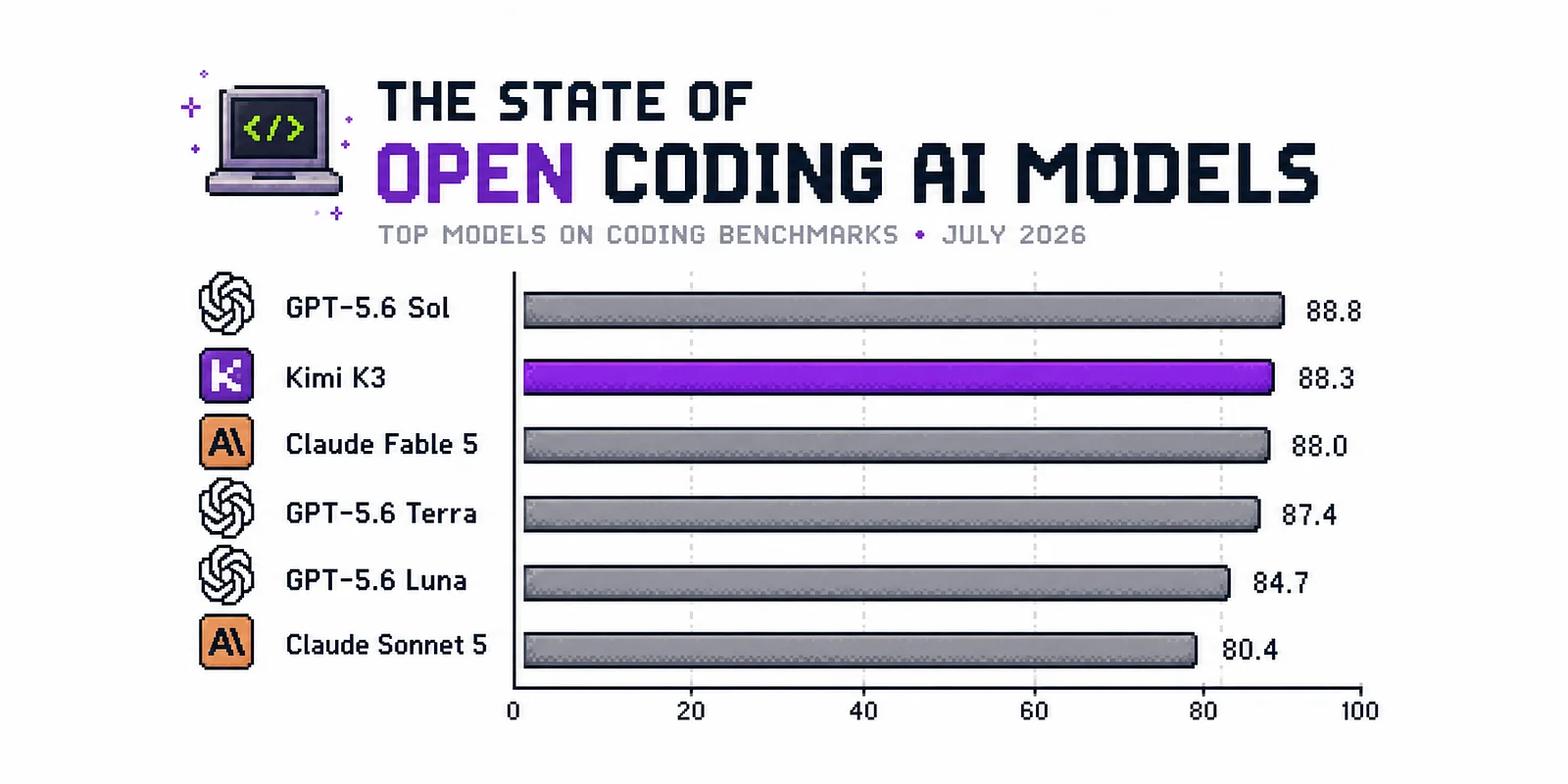
As open models are becoming bigger and bigger, “open” doesn’t automatically mean “local” anymore. This month’s news makes the shift more obvious. Kimi K3 released with a ~2.8T parameter size, file size on hugging face: 1.56 Terabytes. Labs shipping open weight models are on a roll and the big 4 (xAI, Google, Anthropic, OpenAI) are losing their grip it seems.
And with July being packed with so many major releases (both in the closed-, as well as in the open model space) I thought this was a good time to review what we got so far in 2026 and where the journey is heading.
My main theses are:
- That open models are not just for senior engineers (and nerds and outcasts like me) but, as they are closing in on the closed frontier models regarding performance and usability, they are becoming the sensible alternative to a much broader audience.
- Open weights have become the go-to for many agentic-coding circles, and with strong weights arriving from more labs, serving them well is becoming the differentiating factor.
The following is (mostly) a data report and I’ll keep my opinion to a minimum: Model claims are dated and sourced, community signals from r/LocalLLaMA and developer forums are labeled as such, and every model in the comparison table was checked against vendor material in the second half of July 2026.
What developers actually code with now
Ask developers doing agentic coding which models they trust. The models they name are almost all open weights, and Chinese models show up more than you’d expect:
GLM 5.2 from Zhipu gets described in community threads as the most reliable open-weight model for agentic coding, the model you just leave running. It is a 753B MoE with roughly 40B active per token, MIT-licensed, and the recurring complaint is Claude-like verbosity, not correctness. Zhipu’s next flagship, GLM 5.5, is reportedly targeted for August (a JPMorgan note reported by Reuters, June 2026).
Qwen 3.8, in preview, one-shots problems that make other models loop, but it is too large to run at home and gets consumed through Alibaba’s token plan. The broader Qwen family is the common thread all year: a dedicated coder in Qwen3-Coder-Next, and the actual local option in Qwen 3.6, and the frontier preview in Qwen3.8-Max. If you track one family this year, make it Qwen.
DeepSeek V4 shipped as an MIT-licensed preview on 2026–04–24 with a vendor claim of open-source state of the art on agentic-coding benchmarks. Early users found the preview checkpoint rough for agentic work. The final tune will make or break it.
Kimi K3 from Moonshot ranks first on Frontend Code Arena at 1,679, ahead of the closed Fable 5 at 1,631. Moonshot put the weights on Hugging Face on 2026–07–27 under its own Kimi K3 License, MIT-like text with a commercial gate above 20 million dollars in model-as-a-service revenue. At roughly 2.8T parameters, most devs will still reach it through a provider.
Honorable mention: Poolside shipped Laguna S 2.1, an open-weight coding model that runs on a single 128GB workstation, outperforms other similar models in its weight class and is not too far from models over 10 times bigger. That one’s coming up a lot and shows a lot of promise (more below).
Closed models still come up, but interestingly more as flawed peers, not leaders. In these discussions Opus 4.8, GPT-5.6 Sol, and Fable 5 each come with a known weakness the daily users call out. Fable and Opus get called too chatty by default, and GPT 5.6 apparently has a nasty tendency for scope creep and overengineering simple tasks.
Recent open coding models (2026)
The table below is what I put together from my research in the second half of July: You’ll see that plenty of these open models are exclusively accessible through API:
| Model (lab) | Shipped | Size total / active | License | Runs on | Coding angle |
|---|---|---|---|---|---|
| Poolside Laguna S 2.1 | 2026-07-21 | 118B / 8B | OpenMDW-1.1 | single NVIDIA DGX Spark | Western open coder; Poolside reports Terminal-Bench 2.1 70.2 (thinking on), roughly 10 to 12 points behind the closed frontier. 1M context. |
| Kimi K3 (Moonshot) | hosted 2026-07-16, weights 2026-07-27 | ~2.8T MoE | Kimi K3 License (MIT-like, revenue gate) | providers or a very large rig | reported #1 on Frontend Code Arena (1,679, ahead of Fable 5 at 1,631) |
| GLM-5.2 (Zhipu) | 2026-06 | 753B / ~40B active | MIT | providers, large rigs | the reliable agentic workhorse, 1M context |
| Qwen3-Coder-Next | 2026-02 | 80B / 3B | Apache 2.0 | high-VRAM, borderline local | dedicated coder, tiny active slice |
| Qwen3.8-Max (preview) | 2026-07-19 | 2.4T sparse MoE | preview, open weights intended | cloud token plan only | community signal: one-shots hard code, loop-prone; Alibaba’s comparative claims come with little published methodology |
| DeepSeek V4 (preview) | 2026-04-24 | 1.6T / 49B (Pro); 284B / 13B (Flash) | MIT | providers | vendor claims open-source SOTA (80.6% SWE-bench Verified, Pro); preview ran rough |
| Macaron Tall | 2026-07-21 | 50B (35B base plus four 3.7B LoRA specialists, post-trained from Qwen 3.6) | open weights, terms unstated | single box, local | agent coder built on an open base |
| JetBrains Mellum2 | 2026-06-01 | 12B / 2.5B | Apache 2.0 | local | small dedicated coder, ships a Thinking variant |
| gpt-oss (OpenAI) | 2025-08-05 | 117B / 5.1B and 21B / 3.6B | Apache 2.0 | high-VRAM and consumer | first OpenAI open weights since GPT-2, MXFP4, 128K context |
| Qwen 3.6 | 2026-04-15/16 | 27B dense; 35B-A3B MoE | Apache 2.0 | single RTX 5090 at Q4 | Qwen reports 73.4% SWE-bench Verified for the 35B-A3B; the dense 27B edges it at 77.2% |
| KAT-Coder V2.5 Dev (Kwaipilot) | 2026-07-10 | 35B / 3B | Apache 2.0 | single RTX 5090 at Q4 | agent-tuned coder; Kwaipilot reports 69.4% SWE-bench Verified and 41.0 on Terminal-Bench 2.1. Open release is text-only, Pro and Air tiers stay API-only. 262K context |
Every entry checked against the vendor’s own material in July 2026. Benchmark figures are vendor-reported unless noted. MIT, Apache 2.0 and OpenMDW-1.1 are standard open terms with no commercial gate; the rest carry a revenue condition, leave the terms unstated, or are preview-only. Compiled by CloudRift from vendor releases and model cards, July 2026.
TLDR: Which open model for which job:
- Most reliable open workhorse: GLM 5.2.
- Best coder you can run on one box: Poolside Laguna or Macaron Tall.
- Frontier open, too large to self-host: Kimi K3, Qwen 3.8.
- Small, local, or tool-use: Qwen’s smaller sizes, JetBrains Mellum2.
Open versus closed, on coding specifically
The case for open is the models above, plus a lead at the ceiling that’s shrunk to low single digits. DeepSeek’s V4-Flash-0731 card puts an MIT-licensed model 2.3 points behind Claude Opus 4.8 on Terminal-Bench 2.1 and ahead of GLM-5.2. All three scores come from DeepSeek’s harness, so the framing is the vendor’s, but scoring three models in one harness reads cleaner than lining up each lab’s own best figure.
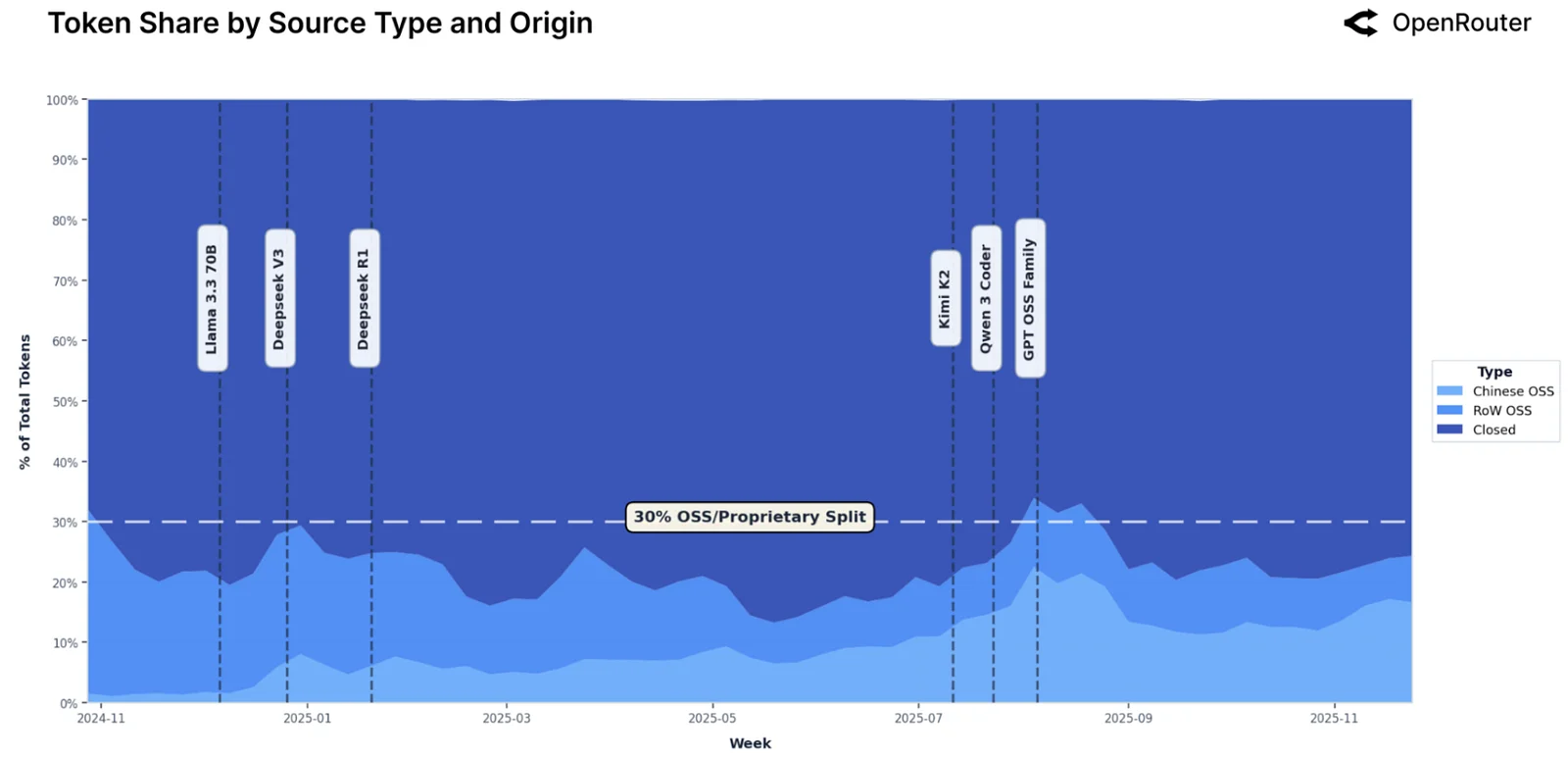
The catch (again) is its size. That score belongs to a 304B model, and the open models that reach the ceiling are the ones almost nobody self-hosts.
Poolside reports 70.2 on Terminal-Bench 2.1 for Laguna, run in its own agent harness, which is strong for a model with only 8B active parameters, and the same numbers put it roughly 10 to 12 points behind Sonnet 5 and GPT-5.6.
Macaron is equally measured about its own open-base agent: it’s close to the frontier, not ahead of it, with Claude Opus leading the charts it publishes. An independent test outside the vendor harness lands in similar territory. A developer ran Laguna S 2.1 against Qwen3.5–122B on a single RTX Pro 6000 96GB under vLLM, reported 109 tokens per second at 256k context and the best tool-call arguments in the comparison, and defended the setup when other users challenged the KV-cache precision.
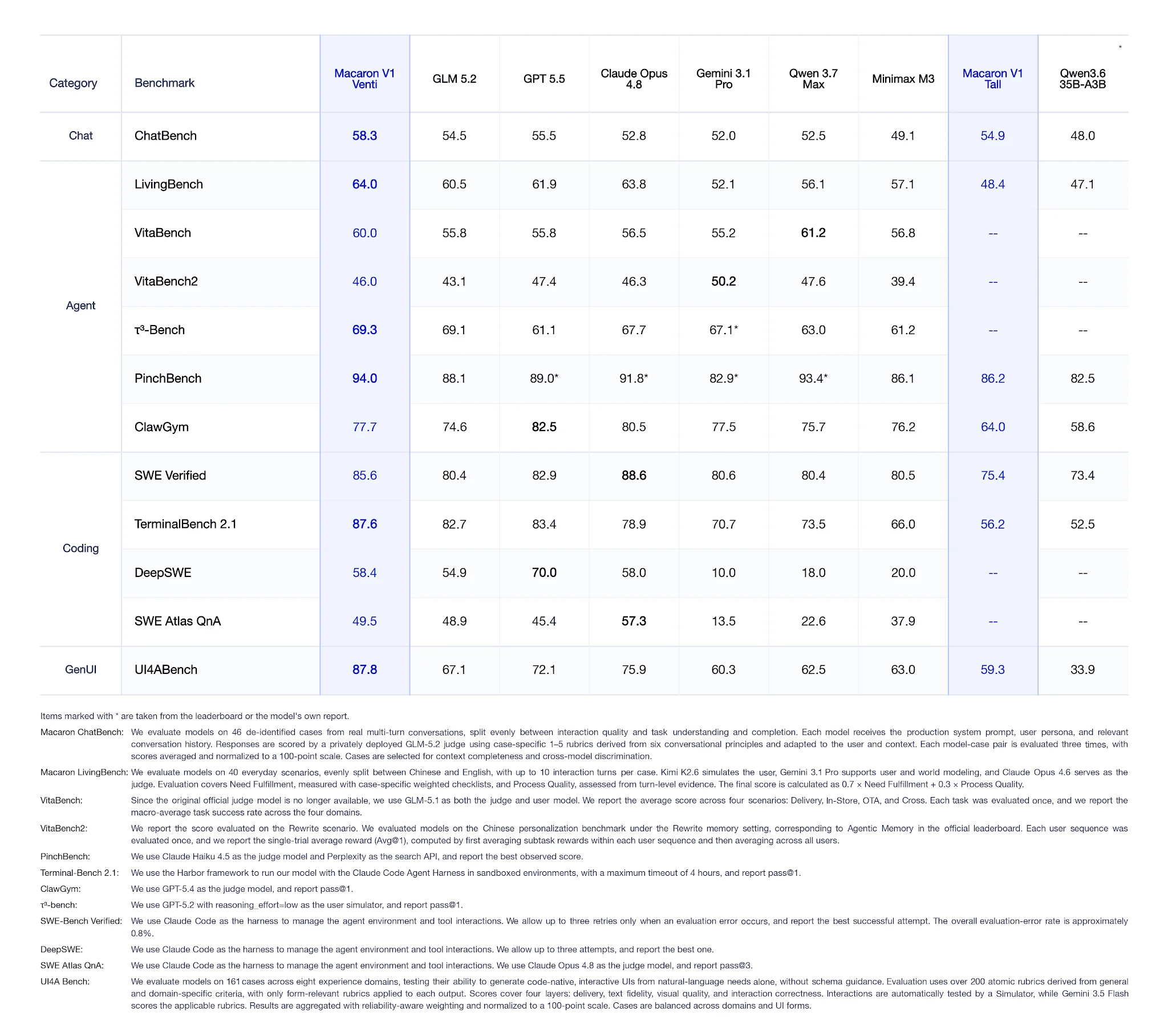
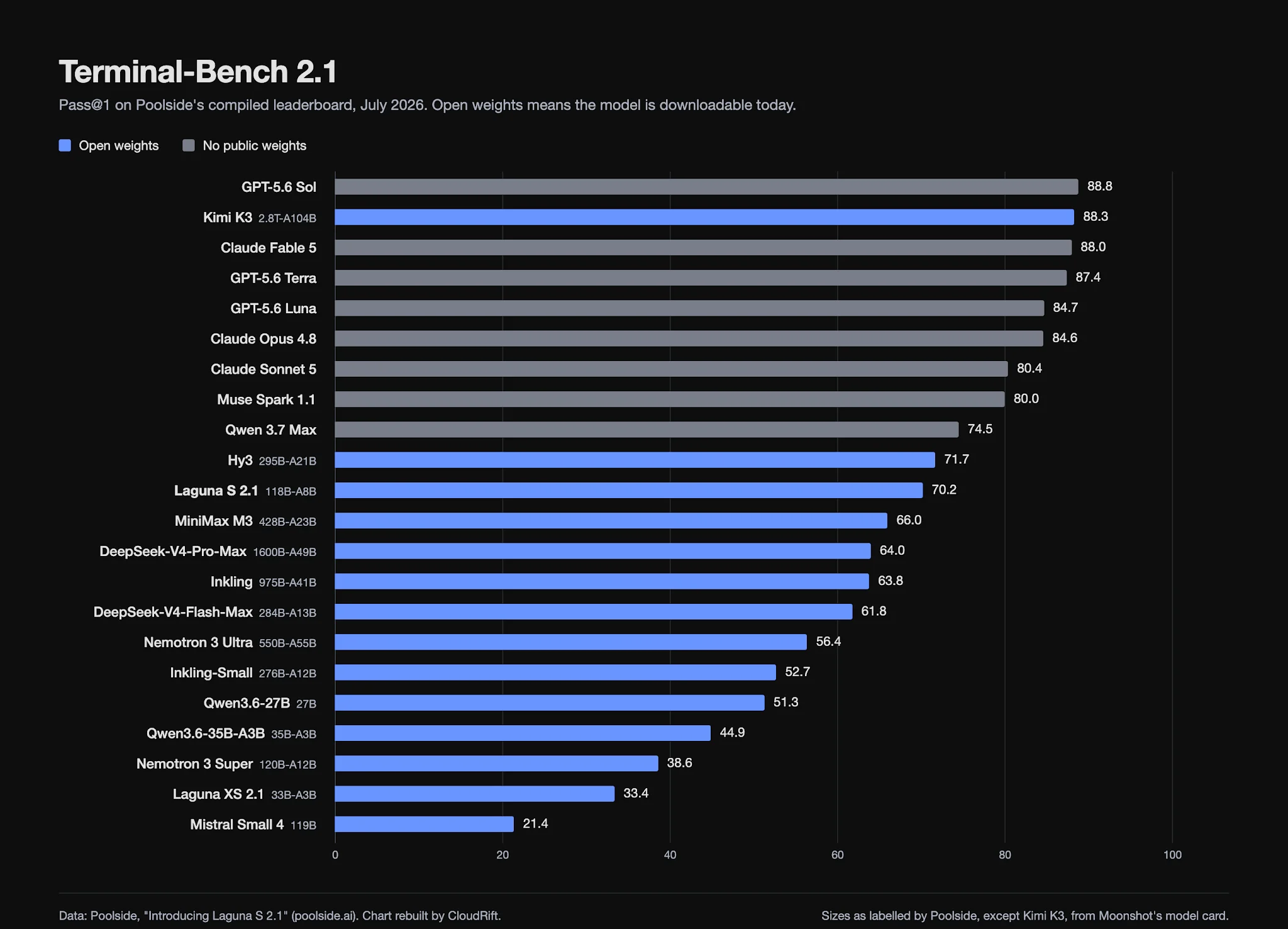
The trend line, tracked by Artificial Analysis, shows the open-to-closed gap on its Intelligence Index narrowing from about 13 points to 6 over the past year, with Kimi K3 at 57.1 landing within roughly three points of Fable 5 and GPT-5.6 Sol. Epoch AI frames the same closing gap as open models trailing the closed frontier by about four months. Take the exact numbers with salt. The same threads that cite them argue over them.
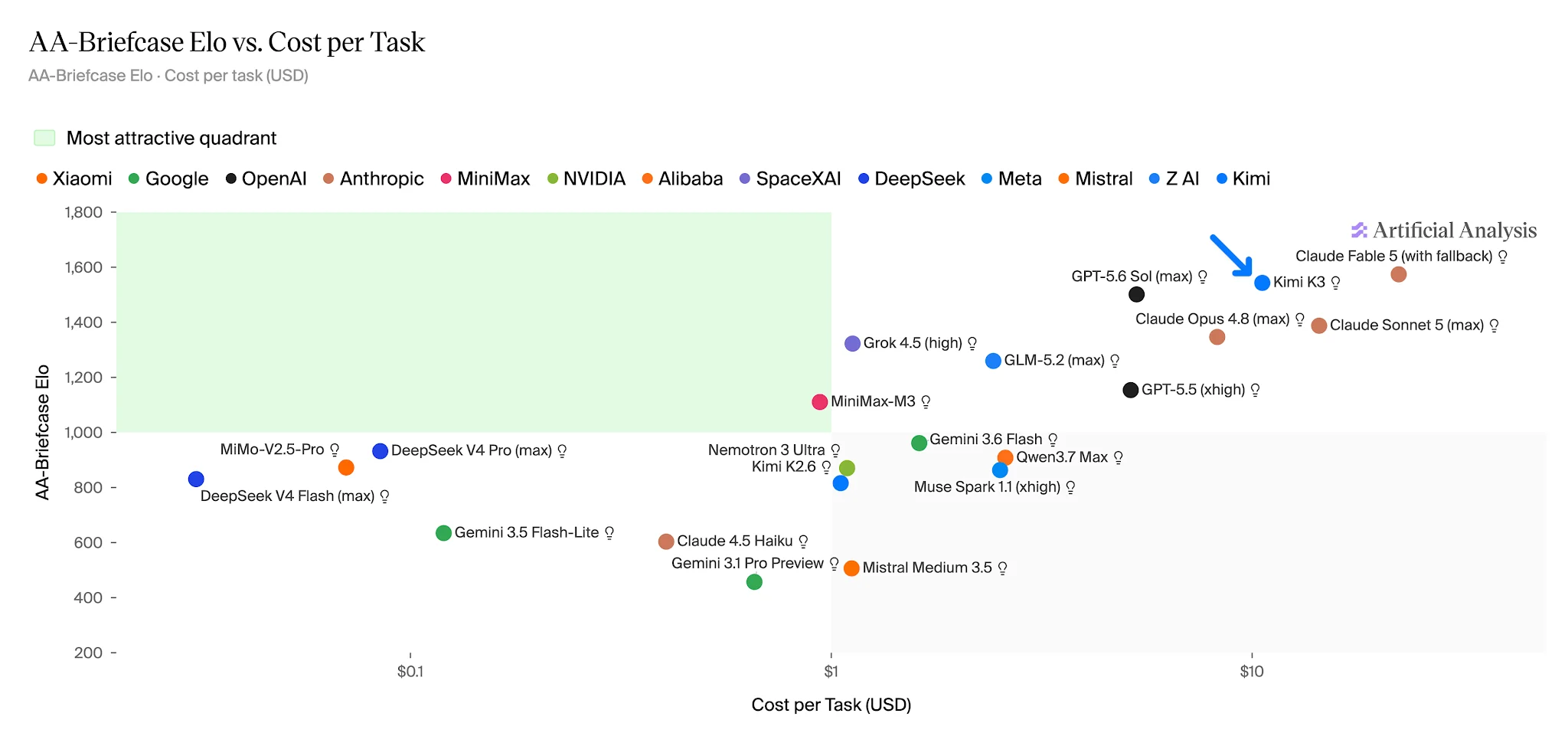
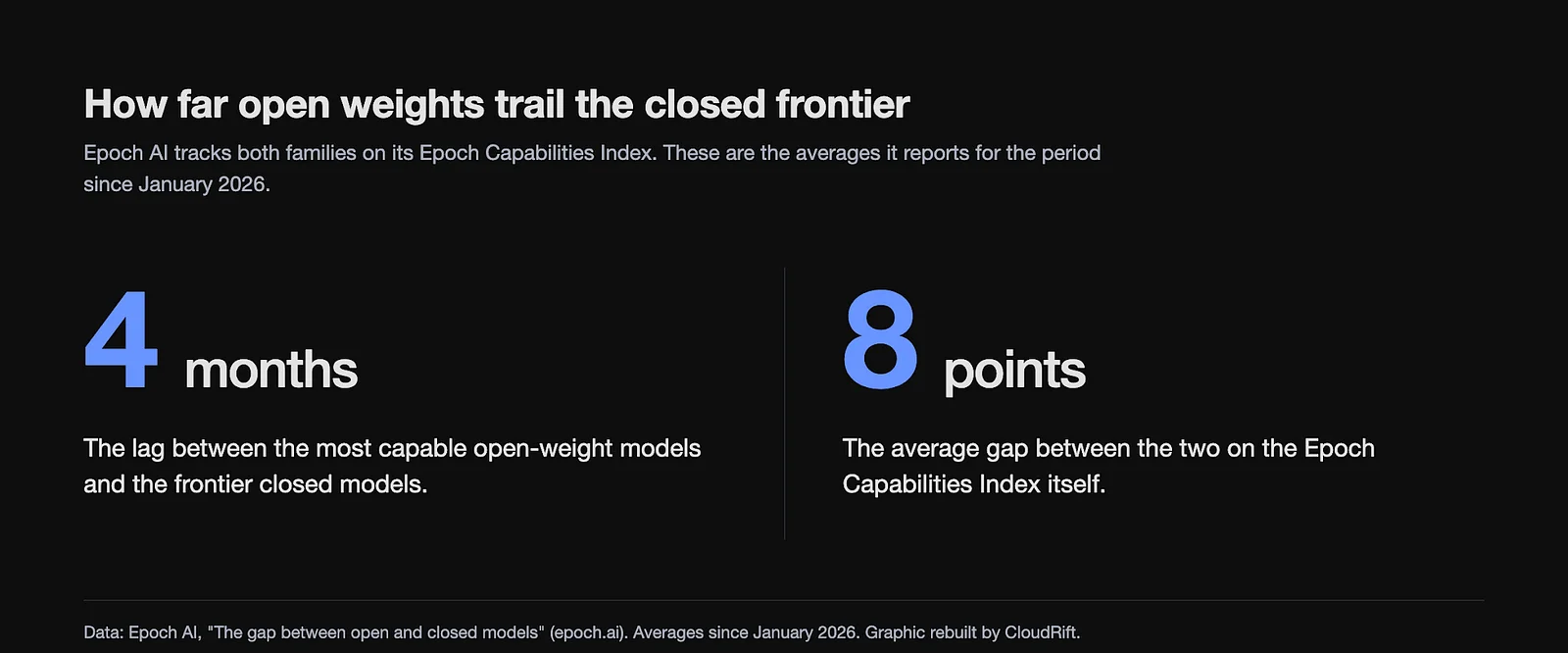
Open carries the daily work in these communities. What closed still holds at the ceiling is a tiny couple of points, contested by open models that need a datacenter to run either way.
Why open won coding for the people doing it
Control drives the decisions more than price does:
An API model can be pulled away from under you. Open weights can’t. When a model lives behind one vendor’s endpoint, that vendor can change it, throttle it, or retire it. An open weight you have downloaded, or that several providers host, keeps working, and you can move it between providers so it won’t be quietly degraded to cut serving costs.
There is also the refusal problem, and July handed it a documented case study. When an autonomous agent breached Hugging Face, the responders first tried commercial APIs and got blocked, because the providers’ guardrails cannot distinguish an incident responder submitting exploit payloads from an attacker. Hugging Face ran the forensics on GLM 5.2 instead, an open weight on its own infrastructure, working through more than 17,000 recorded attack events with none of the attacker data leaving its environment (Hugging Face incident disclosure, July 2026). The best part: the attacker had no such problem.
OpenAI confirmed that the agent ran on GPT-5.6 Sol and an unreleased, more capable model during an internal cyber-capability evaluation, with the usual security guardrails dialed down. Curiously, the model broke out of its test environment before working its way to Hugging Face because it assumed it would find resources that would help it solve the questions posed to it in the testing environment (OpenAI disclosure; Axios, CNBC, July 2026).
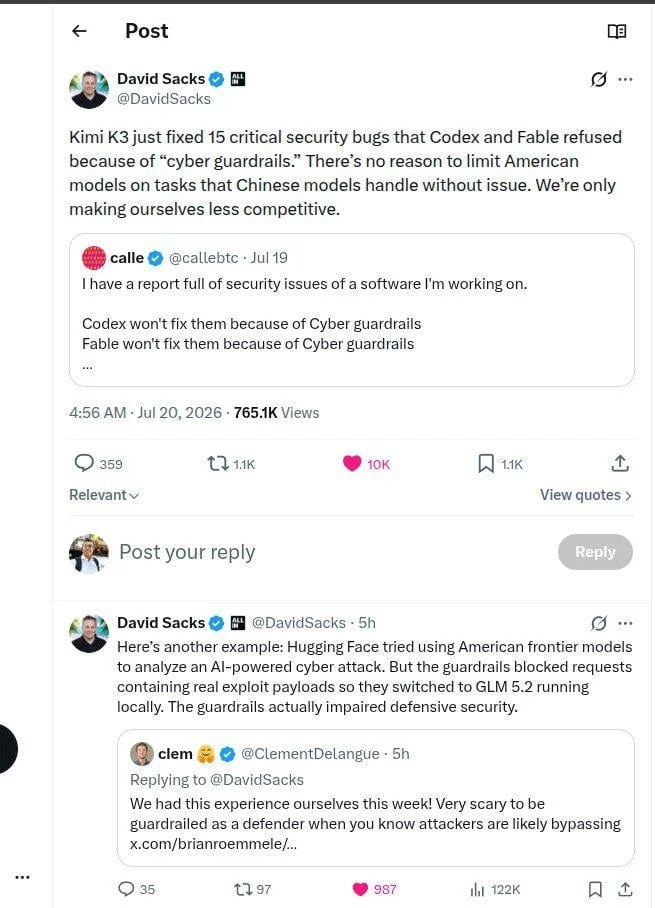
Forums had warned about this for months: frontier models refusing legit security work on guardrail grounds. For security research and anything the filters misread, owning a model that is below frontier level beats a smarter one you can’t reliably steer.
The rest comes down to what coders optimize for. What matters is tokens and steps per finished task, not the top vanity benchmark number. Reliability and low verbosity beat raw capability when an agent loops through a real codebase. Post-training quality matters more than parameter count, which is why a rough preview of a strong base model fails in agentic use.
The size problem: open coding models outgrew local
The best open coders are absolutely enormous. Qwen 3.8, Kimi K3 at roughly 2.8T, and similar frontier models can’t run at home, unless you happen to have a terabyte of VRAM lying around. r/LocalLLaMA users consume them through cloud token plans and inference providers, and more than one Redditor has pointed out that a 2.8T open weight has limited practical value to the local community even when the license is generous. Commoditizing weights doesn’t commoditize hardware. Nobody self-hosts a model that size.
The actually-local tier is smaller and specific. Single-box coders like Poolside Laguna and Macaron Tall run on one machine. Qwen 3.6 ships both a 27B dense model and a 35B-A3B mixture-of-experts model, the latter fitting a single RTX 5090 at Q4 and landing within a few points of the closed frontier on SWE-bench by Qwen’s numbers, closer than the “months behind” forum talk. Kwaipilot’s KAT-Coder V2.5 Dev joined the same class in July, a 35B-A3B model under Apache 2.0 that Kwaipilot scores at 69.4% on SWE-bench Verified, though only the text-only Dev tier is downloadable and the stronger Pro and Air tiers stay behind its API. JetBrains Mellum2 and the smaller Qwen sizes cover fast tool-use.
The community’s ask is clear and unmet. In a 552-comment thread on Qwen 3.8, developers asked to preserve the dense 4B to 27B workhorse band, with the 9B and 14B models singled out as favorites, alongside a distinct request for a 60 to 80B model sized to run at Q6 on a 128GB unified-memory box. The frontier is outrunning the sizes people can actually deploy.
Serving and optimization is the real game now
Since the coding models worth using are too big to self-host, the value shifted from downloading to serving well.
Sparse mixtures of experts cut per-token compute, while the full weights still have to sit in memory. Laguna fits on one machine because its 118B total, quantized, fits inside a 128GB unified-memory machine, and its 8B active slice keeps per-token compute far below what a dense 118B would need. Memory capacity decides who can serve the biggest models, which reframes the hardware question around holding the weights rather than crunching them.
Long context makes it significantly harder. Filling a large context window stacks tens of gigabytes of key-value cache on top of the weights, and that cache is often the difference between a model fitting on your hardware and not. Serving efficiently means managing that memory as much as the model itself.
Kernel-level optimization and speculative decoding are the other levers. Speculative decoding speeds generation by drafting tokens cheaply and verifying them, and squeezing more out of attention kernels is an active research lane. This is where an inference-optimization lab earns its keep. (The open source compiler that our team is working on, Emmy, sits here)
What to watch through the rest of 2026
- Whether the big open coders get smaller distillations that fit consumer GPUs. That’s what collapses the “Consumer Local vs Rich People Local” gap this report is built on.
- Whether post-training quality, not parameter count, becomes what labs compete on for agentic work — because that’s how open models become the sensible choice for the broader audience, not just the nerds.
- Whether enterprise adoption picks up as serving tooling matures. The differentiator isn’t the weights anymore, it’s how well you run them.
- Whether the big-four closed labs (xAI, Google, Anthropic, OpenAI) keep losing their grip on the coding conversation, or whether their next releases force the gap open again.
The coding frontier is open now. The work left is making it run well on the hardware people actually own, and serving it well enough that nobody misses the closed APIs.
Sources
Model claims below were checked against the official vendor material and reporting in July 2026. Community signal from r/LocalLLaMA and developer forums is labeled as such and not treated as benchmark data.
ChatGPT 5.6 weaknesses
Gemini 3.5 Pro delays (2026–07–16)
- Bloomberg, “Google Gemini Launch Delayed as Tech Falls Short of Internal Goals”
- 9to5Google, “Gemini 3.5 Pro delays due to coding performance”
- CNBC, “Alphabet shares fall on report Gemini 3.5 Pro is delayed”
Poolside Laguna S 2.1 (2026–07–21)
- Poolside via GlobeNewswire, launch release
- VentureBeat, “Poolside drops Laguna S 2.1”
- MarkTechPost, Laguna S 2.1 on SWE-Bench Multilingual
Kimi K3 / Frontend Code Arena (hosted 2026–07–16, weights 2026–07–27)
- Tom’s Hardware, “Moonshot releases 2.8-trillion-parameter Kimi K3”
- FourWeekMBA, Kimi K3 tops Frontend Code Arena (1,679 vs Fable 5 1,631)
- Hugging Face, moonshotai/Kimi-K3 model card (2.8T total, 104B active, weights released 2026–07–27)
- Moonshot AI, Kimi K3 License (MIT-like text with a commercial gate above 20 million dollars in model-as-a-service revenue)
Qwen3.8-Max preview (2026–07–19)
- MarkTechPost, Alibaba previews Qwen3.8-Max, 2.4T multimodal
- TechTimes, “Qwen3.8-Max claims second place behind Fable 5, no benchmarks”
GLM-5.2 (Zhipu / Z.ai, June 2026), GLM-5.5 upcoming
- Pandaily, GLM-5.2 open-sourced with 1M context, MIT
- Eigent, GLM-5.2 753B/~40B active, MIT
- AIBase, GLM-5.5 expected in August (JPMorgan note via Reuters, June 2026)
Qwen 3.6 (27B dense 2026–04–15, 35B-A3B MoE 2026–04–16) and Qwen3-Coder-Next
KAT-Coder V2.5 (Kwaipilot, 2026–07–10)
- Hugging Face, Kwaipilot/KAT-Coder-V2.5-Dev model card (35B total / 3B active, Apache 2.0, text-only weights, 262K context)
- Kwaipilot on Hugging Face, model listing (no Pro or Air V2.5 weight repositories)
DeepSeek V4 preview (2026–04–24) and R1 distills
- DeepSeek API docs, V4 Preview release (V4-Pro 1.6T/49B, V4-Flash 284B/13B, MIT)
- Hugging Face, DeepSeek-R1-Distill-Qwen-32B (MIT)
OpenAI gpt-oss (2025–08–05)
- OpenAI, “Introducing gpt-oss”
- Hugging Face, openai/gpt-oss-120b (117B/5.1B, MXFP4, 128K, Apache 2.0)
JetBrains Mellum2 (2026–06–01)
- Hugging Face, “Introducing Mellum2: A 12B MoE” (12B/2.5B, Thinking variant)
- The New Stack, JetBrains open-sources Mellum2
Gemma 4 (2026–04–02, Apache 2.0)
Macaron-V1-Tall (50B: 35B base + four 3.7B LoRA specialists, post-trained from Qwen 3.6)
MiniMax M3 (announced 2026–06–01, weights ~2026–06–07)
IBM Granite 4.0 (Apache 2.0)
OpenRouter usage (token-mix by category)
- OpenRouter, “State of AI 2025: 100 Trillion Token Study” (with a16z)
- arXiv 2601.10088, “State of AI: An Empirical 100 Trillion Token Study with OpenRouter”
Hugging Face breach and the guardrail asymmetry (July 2026)
- Hugging Face, “Security incident disclosure, July 2026” (API guardrails blocked incident response; forensics run on GLM 5.2)
- OpenAI, “OpenAI and Hugging Face partner to address security incident during model evaluation”
- CNBC, “OpenAI cyber models broke out of training environment to hack Hugging Face”
- Axios, “Hugging Face breach: OpenAI claims its models were responsible”
Open-versus-closed trend line
- Artificial Analysis, Kimi K3 on the Intelligence Index (second only to Fable 5)
- Epoch AI, “Open models lag state-of-the-art closed models by 4 months”
Minecraft one-shot demos and the One Shot Challenge (June 2026)
- Digg, “Claude 5 Fable Generates Complete Minecraft Clone”
- Vaibhav Sisinty on X, one-prompt Minecraft clone demo
- Zuhaitz on X, skeptical reply to the demo
- One Shot Challenge, single-prompt runs on isolated servers
The 4060 Ti tokens-per-second figure and other tok/s numbers come from r/LocalLLaMA threads and are cited as community signal, not benchmarks.